
 EN
EN
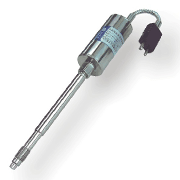
A pressure sensor is a sophisticated device that converts applied pressure into an electrical signal, enabling precise measurement and monitoring of force changes in various industrial applications. These essential instruments have revolutionized how engineers monitor, control, and optimize processes across manufacturing, automotive, aerospace, and countless other sectors. Understanding the fundamental principles and detection mechanisms of pressure sensor technology is crucial for selecting the right solution for specific operational requirements.

Fundamental Operating Principles of Pressure Sensors
Mechanical Deformation and Signal Conversion
The primary mechanism by which a pressure sensor detects force changes involves mechanical deformation of sensitive elements within the device. When external pressure is applied to the sensor's diaphragm or sensing element, this mechanical stress creates a measurable change in the material's physical properties. Most commonly, this deformation alters electrical resistance, capacitance, or generates piezoelectric voltage that can be precisely measured and converted into meaningful pressure readings.
Modern pressure sensor designs incorporate strain gauges, piezoresistive elements, or capacitive plates that respond predictably to applied forces. The relationship between applied pressure and electrical output follows well-established physical principles, allowing engineers to calibrate these devices for exceptional accuracy across wide measurement ranges. This fundamental conversion process enables real-time monitoring of pressure changes with response times often measured in milliseconds.
Transduction Methods and Signal Processing
Different transduction methods allow pressure sensor technology to accommodate diverse measurement requirements and environmental conditions. Piezoresistive pressure sensor variants utilize semiconductor materials whose electrical resistance changes proportionally with applied stress. These devices offer excellent sensitivity and stability, making them ideal for precision applications requiring consistent long-term performance.
Capacitive pressure sensor designs measure changes in capacitance between parallel plates as applied pressure deflects one plate relative to another. This approach provides exceptional resolution and minimal temperature drift, particularly valuable in laboratory and research applications. Signal conditioning circuits amplify and linearize the raw sensor output, converting minute electrical changes into standardized signals compatible with control systems and data acquisition equipment.
Types and Classification of Pressure Sensing Technologies
Absolute and Gauge Pressure Measurement
Pressure sensor classification depends primarily on the reference point used for measurement comparisons. Absolute pressure sensor devices measure pressure relative to a perfect vacuum, providing measurements independent of atmospheric pressure variations. These sensors prove invaluable in applications requiring precise barometric readings or vacuum system monitoring where atmospheric pressure fluctuations could introduce measurement errors.
Gauge pressure sensor instruments measure pressure relative to local atmospheric conditions, making them ideal for most industrial process monitoring applications. The gauge measurement approach simplifies interpretation since readings directly indicate pressure above or below atmospheric levels. This measurement method is particularly useful in hydraulic systems, pneumatic controls, and process equipment where operators need to understand pressure conditions relative to ambient atmospheric pressure.
Differential and Specialized Pressure Sensors
Differential pressure sensor technology measures the pressure difference between two separate input ports, enabling flow measurement, filter monitoring, and level detection applications. These sophisticated devices incorporate dual sensing elements or utilize single elements with dual pressure inputs, providing accurate differential measurements even when both input pressures fluctuate simultaneously.
Specialized pressure sensor variants address specific environmental challenges such as extreme temperatures, corrosive media, or explosive atmospheres. High-temperature pressure sensor designs incorporate specialized materials and construction techniques to maintain accuracy and reliability in harsh industrial environments. These ruggedized instruments often feature ceramic or stainless steel construction with enhanced sealing to withstand demanding operational conditions.
Force Detection Mechanisms and Measurement Principles
Strain Gauge Integration and Force Distribution
The heart of most pressure sensor designs lies in precise strain gauge integration that converts mechanical deformation into measurable electrical signals. When pressure is applied to the sensor's diaphragm, the resulting stress distributes across strategically positioned strain gauges arranged in Wheatstone bridge configurations. This arrangement maximizes signal strength while minimizing temperature effects and common-mode noise that could compromise measurement accuracy.
Force distribution patterns within the pressure sensor's sensing element follow predictable mechanical engineering principles, allowing designers to optimize sensitivity and linearity. The diaphragm thickness, material selection, and strain gauge positioning all influence the sensor's dynamic response and measurement range. Advanced finite element analysis techniques help engineers optimize these parameters to achieve desired performance characteristics while maintaining structural integrity under extreme operating conditions.
Dynamic Response and Frequency Characteristics
Dynamic response characteristics determine how quickly a pressure sensor can accurately track rapidly changing force conditions. The sensor's mass, stiffness, and damping properties influence its natural frequency and ability to respond to transient pressure events without introducing measurement artifacts. High-frequency pressure sensor applications require careful attention to resonant frequency effects that could cause measurement distortions or instability.
Frequency response optimization involves balancing sensitivity against bandwidth requirements, as increasing sensitivity often reduces the sensor's ability to track rapid pressure changes. Modern pressure sensor designs incorporate advanced signal processing techniques and optimized mechanical designs to extend usable frequency ranges while maintaining measurement accuracy. These improvements enable pressure sensor technology to support demanding applications such as engine monitoring, turbomachinery analysis, and vibration measurement.
Industrial Applications and Implementation Considerations
Process Control and Automation Integration
Industrial process control systems rely heavily on accurate pressure sensor feedback to maintain optimal operating conditions and ensure product quality. These instruments provide critical data for automated control loops that regulate everything from steam generation to chemical reaction processes. The pressure sensor output signals integrate seamlessly with programmable logic controllers, distributed control systems, and supervisory control and data acquisition platforms.
Implementation considerations include signal conditioning requirements, communication protocols, and calibration procedures necessary to maintain measurement accuracy over extended operational periods. Modern pressure sensor installations often incorporate digital communication capabilities that enable remote monitoring, diagnostics, and configuration changes without physical access to the sensing location. This connectivity enhances maintenance efficiency while providing valuable operational data for process optimization initiatives.
Safety and Regulatory Compliance
Safety-critical applications demand pressure sensor solutions that meet stringent regulatory requirements and provide fail-safe operation modes. Industries such as nuclear power, pharmaceuticals, and food processing require pressure sensor installations that comply with specific safety standards and documentation requirements. These applications often necessitate redundant sensing systems and continuous monitoring of sensor health to detect potential failures before they compromise system safety.
Regulatory compliance extends beyond basic safety requirements to include environmental protection, electromagnetic compatibility, and industry-specific certification standards. Pressure sensor selection for regulated industries requires careful evaluation of certification requirements, traceability standards, and validation procedures that demonstrate ongoing compliance with applicable regulations. These considerations significantly influence total cost of ownership and operational complexity for pressure sensor installations.
Advanced Features and Technological Innovations
Digital Signal Processing and Smart Sensor Capabilities
Contemporary pressure sensor technology incorporates sophisticated digital signal processing capabilities that enhance measurement accuracy and provide advanced diagnostic features. Built-in microprocessors enable real-time compensation for temperature effects, nonlinearity corrections, and drift monitoring that maintains calibration accuracy over extended periods. These smart pressure sensor features reduce maintenance requirements while improving overall system reliability.
Advanced pressure sensor designs include self-diagnostic capabilities that monitor internal components for signs of degradation or failure. Predictive maintenance algorithms analyze sensor performance trends to identify potential issues before they affect measurement accuracy. These intelligent features enable condition-based maintenance strategies that optimize equipment availability while minimizing unexpected downtime costs.
Wireless Communication and IoT Integration
Wireless pressure sensor technology eliminates installation constraints associated with traditional wired connections while enabling deployment in previously inaccessible locations. Battery-powered wireless sensors incorporate low-power electronics and efficient communication protocols to provide years of maintenance-free operation. These devices support Industrial Internet of Things initiatives by providing distributed pressure monitoring capabilities across large facilities.
IoT-enabled pressure sensor networks facilitate comprehensive facility monitoring and data analytics initiatives that identify optimization opportunities and predict maintenance requirements. Cloud-based data management platforms aggregate pressure sensor data from multiple locations to provide enterprise-wide visibility into operational performance. This connectivity enables advanced analytics applications that correlate pressure sensor data with production metrics, energy consumption, and maintenance activities.
Selection Criteria and Performance Optimization
Accuracy and Environmental Considerations
Selecting the appropriate pressure sensor for specific applications requires careful evaluation of accuracy requirements, environmental conditions, and performance expectations. Temperature effects significantly influence pressure sensor accuracy, necessitating temperature compensation techniques or specialized high-temperature designs for extreme environment applications. Humidity, vibration, and electromagnetic interference also affect sensor performance and must be considered during the selection process.
Long-term stability characteristics determine how frequently pressure sensor calibration must be performed to maintain desired accuracy levels. Premium pressure sensor designs incorporate drift compensation techniques and superior materials that minimize calibration requirements while maintaining measurement integrity. These features prove particularly valuable in critical applications where sensor accessibility is limited or calibration procedures are complex and costly.
Installation and Maintenance Best Practices
Proper pressure sensor installation techniques significantly influence measurement accuracy and operational reliability. Mounting considerations include vibration isolation, thermal effects, and pressure port orientation that could affect measurement performance. Installation procedures must account for pressure line effects, such as resonance and damping, that could introduce measurement errors or reduce sensor lifespan.
Preventive maintenance programs for pressure sensor installations should include regular calibration verification, visual inspection of connections and seals, and performance trending analysis. Calibration intervals depend on application criticality, environmental conditions, and regulatory requirements that mandate specific verification frequencies. Documentation requirements for regulated industries necessitate comprehensive maintenance records that demonstrate ongoing compliance with applicable standards.
FAQ
How does a pressure sensor convert physical force into electrical signals
A pressure sensor converts physical force through mechanical deformation of sensing elements such as diaphragms or strain gauges. When pressure is applied, these elements experience stress that changes their electrical properties, such as resistance or capacitance. This change is then amplified and processed by electronic circuits to produce a standardized electrical output signal proportional to the applied pressure. The conversion process relies on well-established physical principles that ensure consistent and accurate measurement across the sensor's operating range.
What are the main differences between absolute and gauge pressure sensors
Absolute pressure sensors measure pressure relative to a perfect vacuum, providing readings independent of atmospheric pressure changes. Gauge pressure sensors measure pressure relative to local atmospheric conditions, showing how much pressure exists above or below ambient levels. Absolute sensors are ideal for barometric measurements and vacuum applications, while gauge sensors work better for most industrial process monitoring where operators need to understand pressure conditions relative to atmospheric pressure. The choice depends on specific application requirements and measurement objectives.
Can pressure sensors operate reliably in extreme temperature environments
Specialized high-temperature pressure sensors are designed specifically for extreme environment applications using advanced materials and construction techniques. These ruggedized sensors incorporate ceramic sensing elements, high-temperature electronics, and specialized sealing methods to maintain accuracy and reliability in harsh conditions. Standard pressure sensor designs may have temperature limitations, but specialized variants can operate reliably at temperatures exceeding several hundred degrees Celsius while maintaining measurement accuracy and structural integrity.
How often should industrial pressure sensors be calibrated for optimal accuracy
Calibration intervals for industrial pressure sensors depend on application criticality, environmental conditions, accuracy requirements, and regulatory standards. Typical calibration schedules range from monthly for critical safety applications to annually for general process monitoring. Harsh environments or demanding applications may require more frequent calibration verification. Modern smart pressure sensors with drift compensation and self-diagnostic capabilities often extend calibration intervals while maintaining accuracy. Regular performance monitoring helps optimize calibration schedules based on actual sensor stability and operational requirements.
Table of Contents
- Fundamental Operating Principles of Pressure Sensors
- Types and Classification of Pressure Sensing Technologies
- Force Detection Mechanisms and Measurement Principles
- Industrial Applications and Implementation Considerations
- Advanced Features and Technological Innovations
- Selection Criteria and Performance Optimization
-
FAQ
- How does a pressure sensor convert physical force into electrical signals
- What are the main differences between absolute and gauge pressure sensors
- Can pressure sensors operate reliably in extreme temperature environments
- How often should industrial pressure sensors be calibrated for optimal accuracy