
 EN
EN
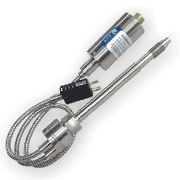
Understanding the fundamental differences between analog and digital pressure sensor technologies is crucial for engineers and system designers making informed decisions about measurement equipment. The choice between analog and digital pressure sensor configurations significantly impacts system performance, accuracy, and integration capabilities across industrial applications.

Modern industrial systems rely heavily on precise pressure measurement technologies to ensure optimal performance and safety standards. Both analog and digital pressure sensor variants offer distinct advantages depending on specific application requirements, environmental conditions, and system architecture considerations. The selection process involves evaluating multiple technical parameters including signal processing capabilities, noise immunity, calibration requirements, and long-term stability characteristics.
Signal Processing Architecture Differences
Analog Signal Characteristics
Analog pressure sensor systems generate continuous voltage or current signals proportional to measured pressure values. These sensors typically produce output signals ranging from 4-20 mA or 0-10V, providing real-time pressure information without discrete sampling intervals. The continuous nature of analog signals allows for immediate response to pressure changes, making them ideal for applications requiring instantaneous feedback and control loop integration.
The signal conditioning circuitry in analog pressure sensor designs focuses on amplification, filtering, and linearization of the raw transducer output. Temperature compensation circuits are often integrated to minimize thermal drift effects on measurement accuracy. However, analog signals are inherently susceptible to electrical noise interference during transmission over long cable runs, potentially affecting measurement precision in industrial environments.
Digital Signal Processing Advantages
Digital pressure sensor architectures incorporate analog-to-digital conversion directly within the sensor housing, transmitting discrete digital data rather than continuous analog signals. This approach eliminates signal degradation concerns associated with cable length and electromagnetic interference. Digital sensors often include microprocessor-based calibration routines that automatically compensate for temperature effects, nonlinearity, and aging characteristics.
Advanced digital pressure sensor models feature programmable measurement ranges, user-configurable alarm thresholds, and diagnostic capabilities that enhance system reliability. The digital communication protocols commonly employed include Modbus, HART, or proprietary fieldbus standards that enable bidirectional data exchange between sensors and control systems. These communication capabilities facilitate remote configuration changes and real-time diagnostic monitoring without physical access to sensor locations.
Accuracy and Calibration Considerations
Measurement Precision Factors
Analog pressure sensor accuracy depends significantly on external signal conditioning components and cable characteristics. The measurement chain includes multiple potential error sources such as amplifier drift, temperature coefficients of external components, and electrical noise pickup. Calibration procedures for analog systems typically require adjustment of both sensor output and receiving instrument parameters to achieve optimal accuracy.
Long-term stability of analog pressure sensor systems requires periodic recalibration to compensate for component aging and drift effects. The calibration process involves comparing sensor output against known pressure standards at multiple points across the measurement range. Environmental factors such as temperature fluctuations and mechanical vibration can affect analog sensor performance over time.
Digital Sensor Calibration Benefits
Digital pressure sensor systems offer superior calibration stability through software-based correction algorithms and lookup tables stored in non-volatile memory. Multi-point calibration data enables precise linearization and temperature compensation without external adjustment requirements. The digital format eliminates errors associated with analog signal transmission and external signal conditioning components.
Factory calibration procedures for digital sensors often include comprehensive characterization across temperature and pressure ranges, with correction coefficients stored permanently within sensor memory. Field calibration can be performed remotely through digital communication interfaces, reducing maintenance costs and system downtime. Some advanced digital pressure sensor models feature self-diagnostic capabilities that detect sensor degradation and automatically trigger recalibration requests.
Installation and Integration Requirements
Wiring and Connection Complexity
Analog pressure sensor installations typically require dedicated shielded cables for each sensor to minimize noise interference and signal degradation. Power supply requirements are generally straightforward, with many analog sensors operating on standard 24V DC industrial power sources. Loop-powered configurations eliminate separate power connections by utilizing the measurement signal path for sensor power transmission.
Cable length limitations for analog pressure sensor systems depend on signal levels and acceptable noise margins. Current loop signals demonstrate better noise immunity compared to voltage outputs, enabling longer cable runs without significant accuracy degradation. Proper grounding techniques and cable shielding are essential for maintaining measurement integrity in electrically noisy industrial environments.
Digital Communication Integration
Digital pressure sensor networks often utilize shared communication buses that reduce overall wiring complexity in multi-sensor installations. Fieldbus protocols enable multiple sensors to share single cable runs, significantly reducing installation costs and maintenance requirements. However, digital systems require more sophisticated configuration tools and protocol knowledge for proper setup and troubleshooting.
Network topology considerations become important with digital pressure sensor systems, particularly regarding bus termination, signal integrity, and fault isolation capabilities. Communication speed limitations may affect system response times in applications requiring rapid pressure measurement updates. Power supply requirements for digital sensors are typically higher due to internal processing circuitry and communication interface components.
Cost Analysis and Economic Factors
Initial Investment Considerations
Analog pressure sensor systems generally offer lower initial hardware costs compared to equivalent digital alternatives. The simplicity of analog signal processing reduces manufacturing complexity and component requirements within sensor assemblies. However, system-level costs must include signal conditioning equipment, calibration instruments, and installation materials required for analog implementations.
Digital pressure sensor pricing reflects the additional complexity of internal analog-to-digital conversion, microprocessor control, and communication interface components. Despite higher individual sensor costs, digital systems may provide overall economic advantages through reduced installation complexity and enhanced diagnostic capabilities that minimize maintenance requirements over the operational lifetime.
Long-term Operational Costs
Maintenance costs for analog pressure sensor systems include periodic calibration services, signal conditioning component replacement, and troubleshooting of cable-related issues. The distributed nature of analog signal processing components increases potential failure points and associated repair costs. Calibration frequency requirements directly impact ongoing operational expenses.
Digital pressure sensor maintenance typically focuses on communication network integrity and software configuration management rather than hardware component replacement. Remote diagnostic capabilities enable predictive maintenance strategies that reduce unplanned downtime and emergency repair costs. The enhanced stability of digital calibration reduces the frequency of required accuracy verification procedures.
Application-Specific Performance Characteristics
Industrial Process Control Applications
Process control systems utilizing analog pressure sensor technology benefit from continuous signal availability and direct integration with analog control loops. PID controllers and valve positioning systems often operate more efficiently with analog input signals that provide seamless pressure feedback without conversion delays. The simplicity of analog signal processing enables straightforward troubleshooting and system optimization procedures.
High-speed process control applications may require rapid pressure measurement updates that favor analog sensor implementations. The continuous nature of analog signals eliminates sampling rate limitations inherent in digital conversion processes. However, noise immunity concerns may limit analog sensor performance in electrically harsh industrial environments.
Data Acquisition and Monitoring Systems
Modern data acquisition systems increasingly favor digital pressure sensor integration due to enhanced accuracy, diagnostic capabilities, and network connectivity features. Digital sensors provide timestamps, measurement quality indicators, and configuration status information that enrich data logging capabilities. The elimination of analog-to-digital conversion errors at the data acquisition level improves overall system accuracy.
Remote monitoring applications particularly benefit from digital pressure sensor implementations that support long-distance communication without signal degradation. Wireless communication options available with some digital sensors enable pressure monitoring in locations where cable installation is impractical or cost-prohibitive. Battery-powered digital sensors with low power consumption extend operational life in remote installations.
Environmental and Durability Considerations
Temperature and Environmental Stability
Analog pressure sensor performance varies significantly with temperature changes affecting both sensor elements and external signal conditioning components. Temperature coefficients must be considered across the entire measurement chain to maintain accuracy specifications. Environmental factors such as humidity, vibration, and electromagnetic interference can degrade analog signal quality over time.
Digital pressure sensor designs incorporate temperature compensation algorithms and environmental protection features within sealed sensor housings. Internal temperature sensors enable real-time compensation for thermal effects on measurement accuracy. The digital signal format eliminates environmental degradation concerns associated with analog signal transmission over long distances.
Long-term Reliability Factors
Component aging effects in analog pressure sensor systems require ongoing monitoring and periodic replacement of signal conditioning electronics. Drift characteristics of analog components may necessitate more frequent calibration procedures to maintain measurement accuracy. Cable degradation and connector corrosion represent additional reliability concerns in harsh environmental conditions.
Digital pressure sensor reliability benefits from reduced component count and solid-state electronics with fewer failure modes. Flash memory storage of calibration data provides long-term stability without mechanical adjustment requirements. Diagnostic features enable early detection of sensor degradation before measurement accuracy is significantly affected.
FAQ
What are the main advantages of digital pressure sensors over analog versions
Digital pressure sensors offer superior noise immunity, enhanced accuracy through built-in compensation algorithms, remote configuration capabilities, and integrated diagnostic features. They eliminate signal degradation issues associated with long cable runs and provide bidirectional communication with control systems for advanced monitoring and troubleshooting capabilities.
How do installation costs compare between analog and digital pressure sensor systems
While digital sensors typically cost more initially, they often reduce overall installation expenses through simplified wiring requirements and shared communication networks. Analog systems require dedicated shielded cables for each sensor, whereas digital systems can utilize fieldbus networks that support multiple sensors on single cable runs.
Which type of pressure sensor provides better long-term accuracy
Digital pressure sensors generally maintain better long-term accuracy due to software-based calibration correction and reduced susceptibility to component drift. Factory-stored calibration coefficients and temperature compensation algorithms minimize accuracy degradation over time compared to analog systems that rely on external signal conditioning components.
Are there specific applications where analog pressure sensors are preferred
Analog pressure sensors remain preferred for high-speed control applications requiring immediate response, simple retrofit installations where digital communication infrastructure is unavailable, and cost-sensitive applications where basic pressure measurement functionality meets requirements without advanced features.
Table of Contents
- Signal Processing Architecture Differences
- Accuracy and Calibration Considerations
- Installation and Integration Requirements
- Cost Analysis and Economic Factors
- Application-Specific Performance Characteristics
- Environmental and Durability Considerations
-
FAQ
- What are the main advantages of digital pressure sensors over analog versions
- How do installation costs compare between analog and digital pressure sensor systems
- Which type of pressure sensor provides better long-term accuracy
- Are there specific applications where analog pressure sensors are preferred